The Sacred Valley of the Incas is a long, fertile valley that lies between Cusco and Machu Picchu, Peru. The Sacred Valley has been the center of agriculture since Inca times. The Incas inhabited this valley over 500 years ago and the remaining archaeological sites are a testament to the their rich and busy lives. They built fortresses, agricultural terraces, temples, palaces and citadels – all of which can be experienced today.
Join us and the guides to learn about the the history and culture of these iconic Inca landmarks during our tour:
Culinary Peru & Machu Picchu
April 26 – May 4, 2017
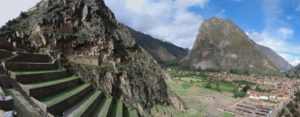 Ollantaytambo Ruins
Ollaytaytambo is both a village and a spectacular Inca archeological site in the Sacred Valley. Built by the Incas as a fortress/temple/palace (no one really knows the reason), it is made of steep terraces guarding a ceremonial platform at the top. The terraces were thought to have been used for agriculture and protection. At the top, lies the ‘Temple of the Sun’, an unfinished construction in front of a wall of enormous boulders. The rock work from both the cut stones (some over 20 feet high) and the field stones is amazing as well as the question of how the Incas were able to transport and build this on a hillside.
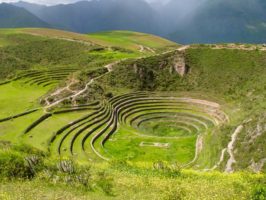 Moray Agricultural Terraces
The ampitheater-like arrangement of Moray’s concentric terraces may appear as an elegant display of architectural simplicity, but according to some theories, their range of widths and depths within the earth resulted in each terrace having a unique agricultural microclimate. These distinctive microclimates allowed ancient farmers to test crops and determine optimal growing conditions. With a 15 degree Celsius (59 degree Fahrenheit) difference from top to bottom, a range of crops were grown on the terraces to determine what and how to grow best.
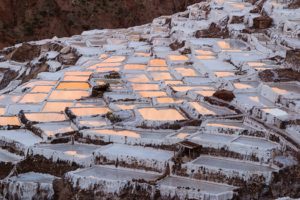 Salt Pans of Maras
Maras is a small town the Sacred Valley well-known for its salt evaporation ponds in use since Inca times. A natural spring feeds a salt-rich stream that flows down a hillside into several thousand ‘pans’. Salt was harvested by the Incas and is still harvested today. The light pink hue of the water in the pans is alluring as is the site itself.
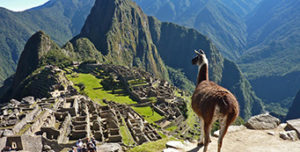 Machu Picchu
The breathtaking Inca citadel of Machu Picchu is a UNESCO World Heritage Site and one of the Seven Wonders of the World. Machu Picchu is believed to have been a royal estate or sacred religious site for Inca leaders. The site stretches over 5 miles and features more than 3,000 stone steps that link its many different levels. its giant walls, terraces and ramps seems as if they have been cut naturally in the continuous rock escarpments. Located on the eastern slopes of the Andes, it is South America’s most famed creation of the Inca Empire.
 Peru has one of the most exciting culinary scenes in the world. Often referred to as ‘Fusion Cuisine’, it draws from Spanish, French, Italian, Asian, Arab and African cuisine to combine with local meats, produce, grains and seafood. Peru’s culinary world also incorporates the foods and traditional preparations from the three major regions of Peru – the Andes, the Amazon and the coast.
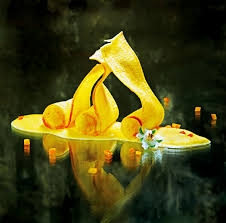 Lima, in particular, has experienced a gastronomic explosion. It was named the world’s leading culinary destination by the World of Travel Awards. Lima has emerged as South America’s food capital for creative, delicious, fusion-inspired dishes.
 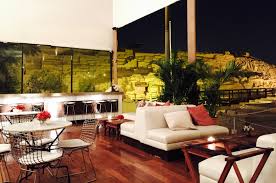 We can’t think of a better way to experience Lima than through its exceptional fusion cuisine!
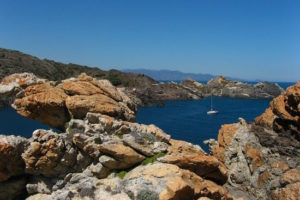
 Spain’s Cap de Creus is a rocky peninsula on the northern-most coast of Spain. Home to Cap de Creus National Park, this area is characterized by jagged volcanic rock formations, the azure sea, crashing waves, hidden sandy beaches and the home of Salvadore Dali, it is a check mark for anyone’s bucket list.
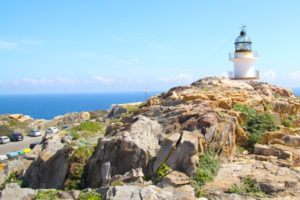 Our fall tour,
 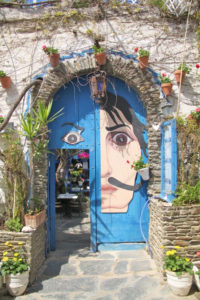 This was Salvadore Dali’s home base where he lived, played and worked. He spent hours walking along the rugged shore observing the light, shadow and rock formations. This landscape immediately causes the mind to race trying to figure out what the rock formations look like… camels, birds, rabbits? Standing high on one of the many peaks in the Cap de Creus National Park, it’s hard not to imagine yourself an adventurer, looking toward the horizon and wondering what could lie beyond. Just like it was for Dali, this is inspiring landscape beckoning you to create in order to capture the moment of the intense beauty of this primitive coastline.
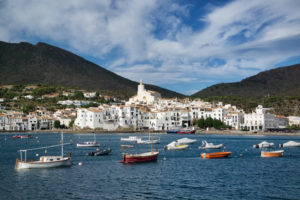 The town of Cadaques, a picturesque fishing village nearby, is filled with cafes,boutiques and local artisan shops. It is a picture postcard of fishing boats bobbing on the water set against whitewashed buildings covered in bouganvillas. It is an enchanting place and will be our hub while on the Costa Brava. Get your paella, your menu of the day or the fresh catch just off the boat. Tapas abound…
 You can see Dali’s influence in Cadaques. We will visit his home at Port Lligatt on Cap de Creus and well as his restaurant in town. It was Cadaques where he found peace and energy to create.
 We can’t think of a more lovely place to visit! So, we’ll stay….for awhile.